
News
Korea–China–Taiwan Compete to Build a Photonic Semiconductor Ecosystem Using Micro LEDs
sigetronics
2026-02-10
Number of views 1,129
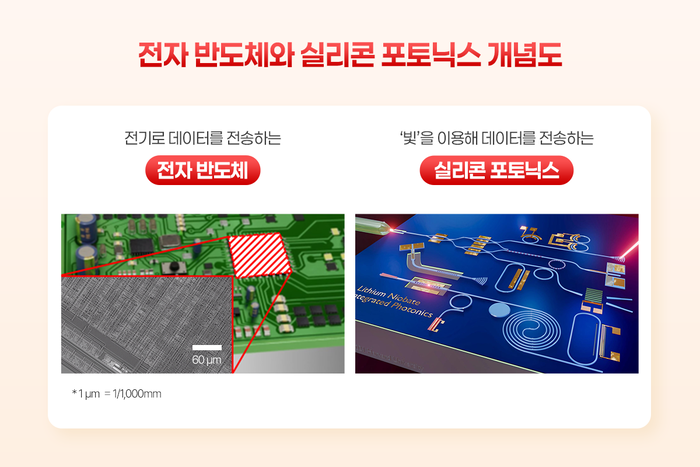
A conceptual diagram of electronic semiconductors and silicon photonics. (Source: LX Semicon Newsroom)
Competition to build a silicon photonics (photonic semiconductor) ecosystem using micro light-emitting diodes (micro LEDs) is intensifying in Taiwan and China, drawing growing attention. Silicon photonics is regarded as a next-generation technology capable of resolving data-transfer bottlenecks driven by the rapid advancement of artificial intelligence (AI).
PlayNitride, a Taiwanese manufacturer of micro LED devices, recently announced a strategic partnership with Brillnics, an optical engine and photonic integrated circuit (IC) design company, to develop a next-generation array-based optical interconnect solution based on green micro LEDs.
Meanwhile, BOE Huacan, a subsidiary of China’s largest display maker BOE, has entered into a strategic cooperation agreement with chip-design specialist Xinxiang Micro. The partnership aims to establish vertical integration covering chip manufacturing and driver design. BOE Huacan operates a mass-production line for micro LED chips based on 6-inch wafers and plans to leverage this capability to enhance the price competitiveness of micro LEDs optimized for optical data transmission.
These moves suggest that both Taiwan and China are building technology ecosystems centered on micro LED chip (device) manufacturers—an area where they hold strong advantages—ahead of the technology’s full-scale commercialization.
Silicon photonics is a technology that uses light, rather than electrical signals, as the transmission medium within circuits. For example, current connections between graphics processing units (GPUs) and high-bandwidth memory (HBM) rely on copper wiring, but silicon photonics replaces these electrical interconnects with optical links.
Among optical transmission technologies, micro LED light sources are gaining attention. Traditionally, laser sources have been used for optical communication, but micro LEDs offer advantages in terms of lower power consumption and cost. Since the optical communication distances required for AI semiconductors are only on the order of a few centimeters, low-power and low-cost micro LEDs are considered particularly well suited.
Micro LED-based optical transmission technology remains in the research stage, with U.S. company Ayar Labs leading development. In Korea, Samsung Electronics and SK hynix have invested in Ayar Labs, and Taiwan’s TSMC also signed a technology collaboration partnership with the company in April last year.
However, Korea lacks domestic manufacturers of micro LED chips, making alternative strategies unavoidable. In July last year, LC Square, which holds mass-transfer technology for micro LEDs, and Sigetronics, which possesses photodetector technology, announced a joint development project for optical transmission modules for silicon photonics. As such, there are growing calls for Korea to prepare its own technology ecosystem by leveraging areas where it has technological strengths.
An industry insider commented, “To apply micro LEDs to silicon photonics, a wide range of capabilities is required, including LED devices, mass transfer, photodetectors, communication-optimized semiconductor IC design, and foundry services. Enhancing insufficient semiconductor design capabilities or securing competitiveness based on core technologies where Korea already excels will be essential.”
ETNews, lloydmind@etnews.com, February 8, 2026
하단영역

Sigetronics, Inc.
ADDRESS : 497, TechnoValley-ro, Bongdong-eup, Wanju-gun, Jeonbuk, Korea
TEL : 82-63-262-4650
FAX : 82-63-262-4660 E-mail : sales@sigetronics.com
COPYRIGHT©2022 SIGETRONICS. ALL RIGHTS RESERVED.
FAX : 82-63-262-4660 E-mail : sales@sigetronics.com
COPYRIGHT©2022 SIGETRONICS. ALL RIGHTS RESERVED.
